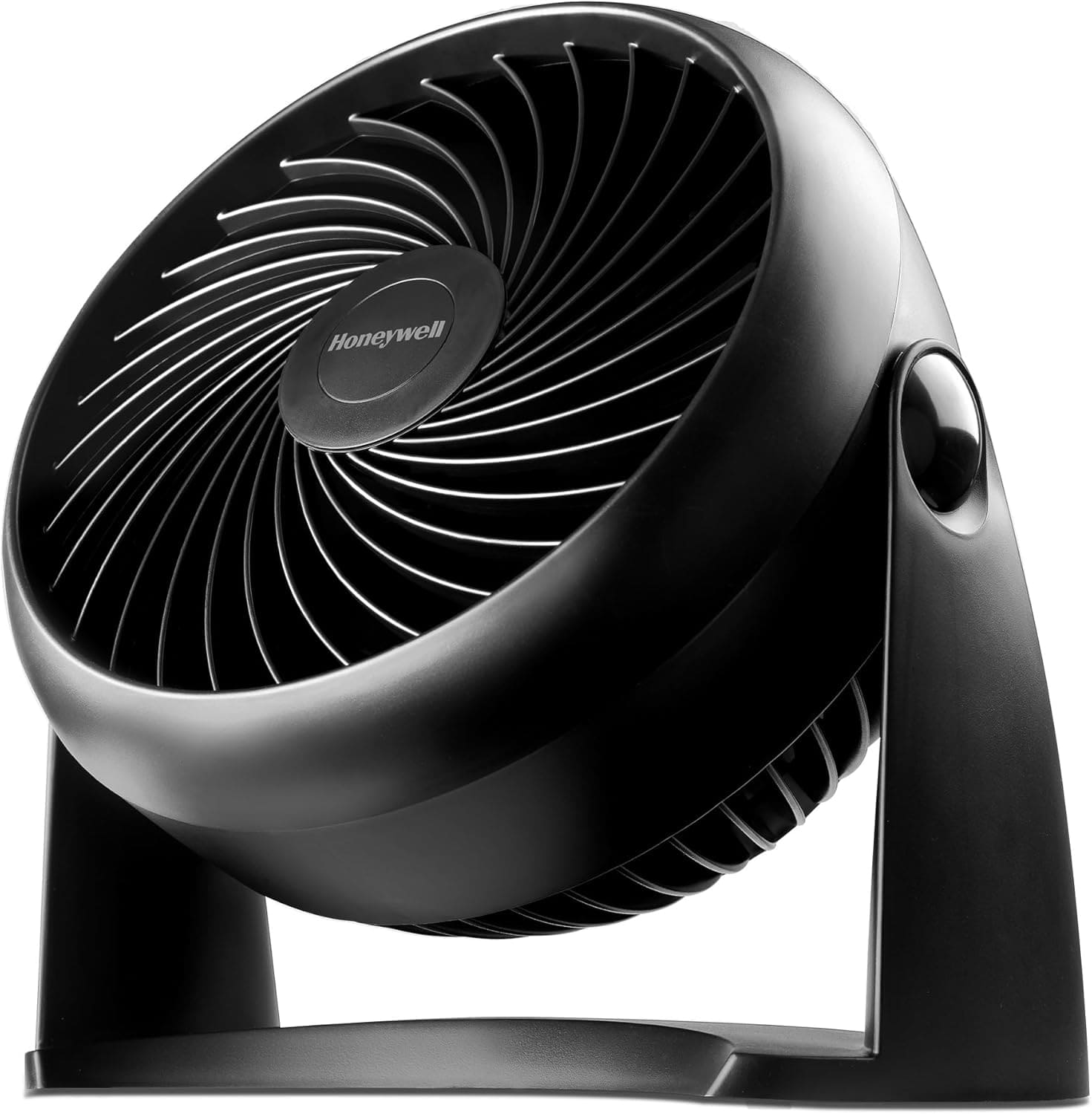
I take small cooling fans seriously because size alone tells you very little about real usefulness. I look at airflow strength, noise, control layout, direction adjustment, cleaning, placement options, room size, and long-term convenience. For this Honeywell TurboForce HT900 assessment, I checked Honeywell’s current specifications, product documentation, safety guidance, and competing compact air circulators. I also looked closely at how its design would work during common daily situations such as sleeping, desk work, home-office use, and helping an air conditioner move cool air. I will point out both the strong and weak areas instead of treating every feature as a selling point, so you can decide whether the HT900 makes sense for your room and budget.
✅ What Works Well
- Strong airflow from a small body
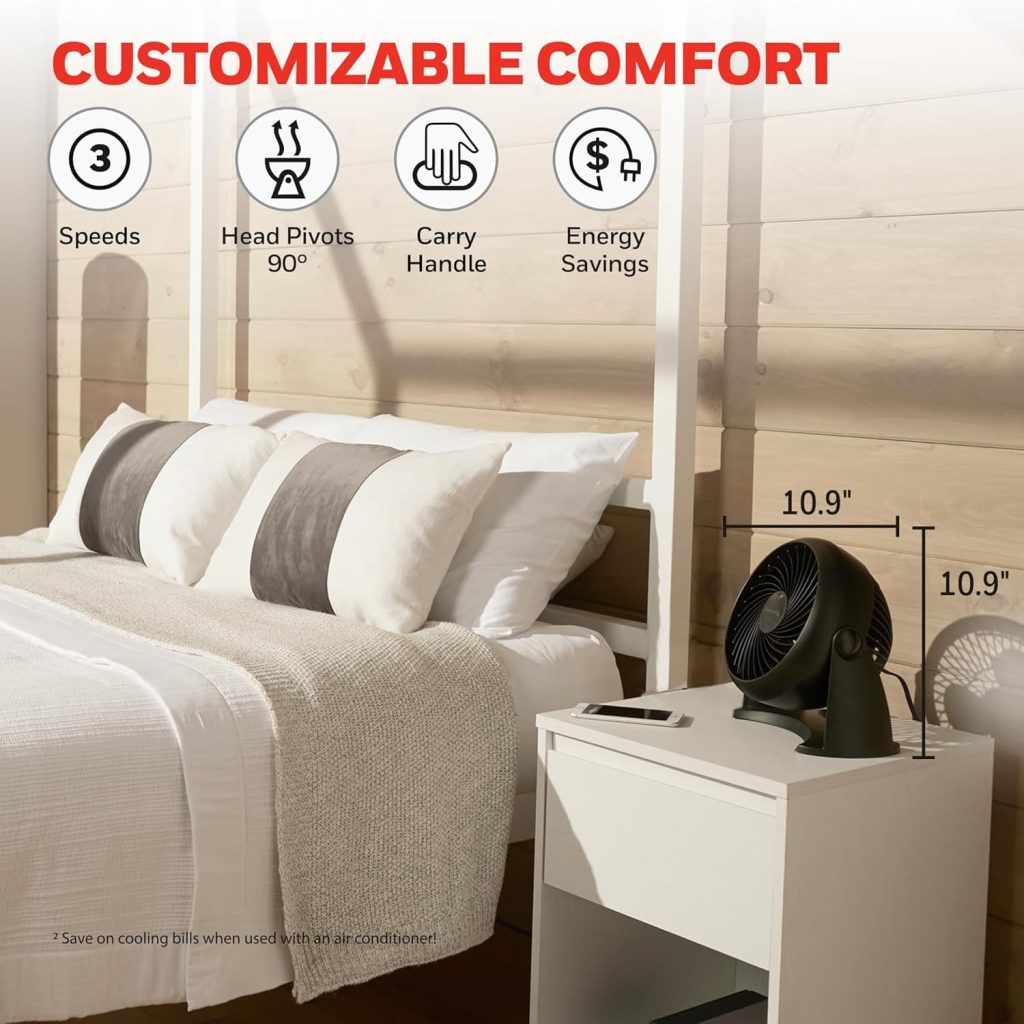
- Three fan speeds
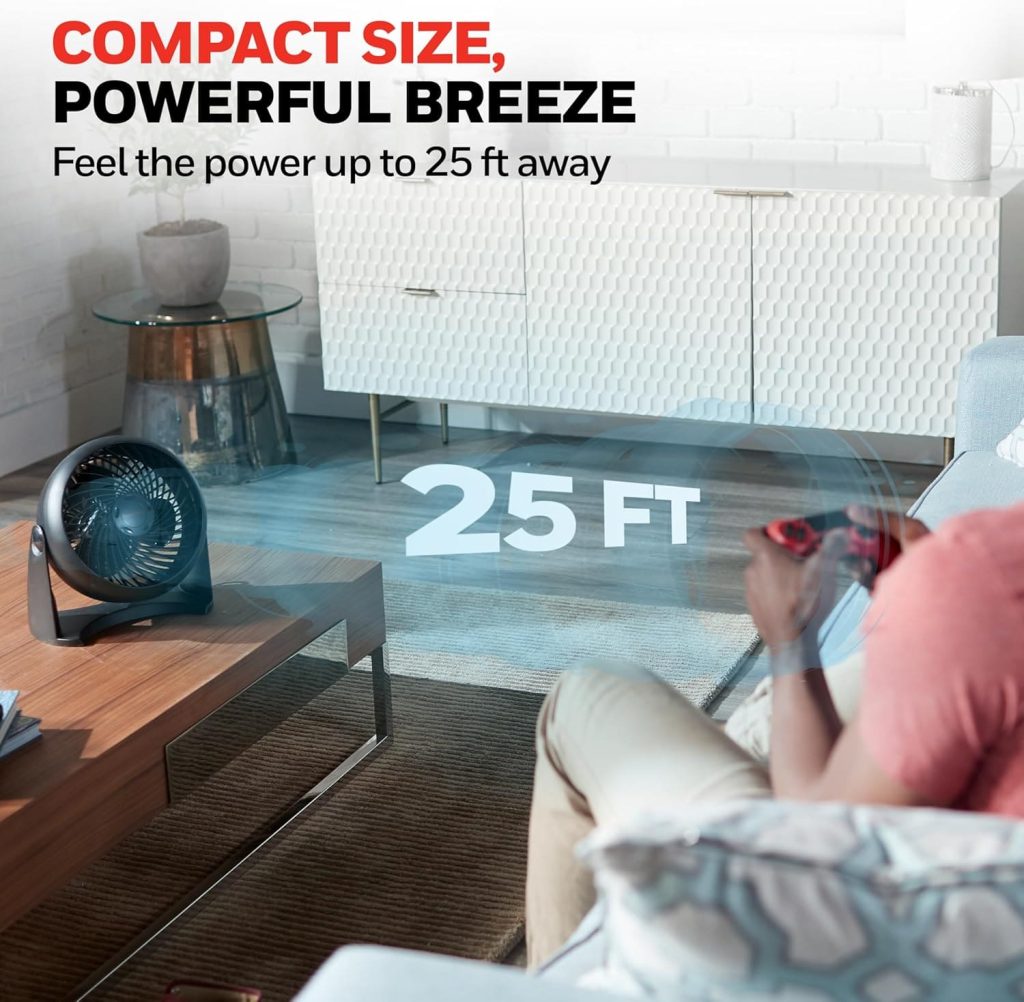
- Air can be felt from up to 25 feet away, according to Honeywell’s internal testing
- Head tilts through a 90-degree range
- Compact enough for a desk, table, counter, or floor
- Can be mounted on a wall
- Maximum airflow is listed at 185 CFM
- Designed for small to medium rooms
- Removable front grille makes deeper cleaning possible
- Built-in carrying area makes moving it easier
- Fused safety plug
- Simple physical controls
- Useful for moving air from an air conditioner or heating system
- Honeywell says it is 25% quieter than comparable fans
- Lightweight at about 2.6 lb
- No complicated setup or app is needed
Honeywell lists three speeds, a 90-degree adjustable head, wall-mounting support, removable grille, 185 CFM maximum airflow, and a weight of 2.6 lb. The brand also states that the fan is 25% quieter than comparable models and that airflow can be felt from up to 25 feet away.
⚠️ Things I Would Consider Before Buying
- It does not automatically swing from side to side
- No remote control
- No timer
- No digital display
- No smart-home controls
- The strongest setting will naturally be more noticeable than the lowest setting
- It is designed for indoor household use
- You need a screwdriver to remove the grille for deeper cleaning
- Wall-mounting screws are not supplied
- A one-year warranty is shorter than the warranty offered with some Vornado competitors
- It is better at focused circulation than broad automatic oscillation
- People wanting whole-room coverage without adjusting direction may prefer an oscillating model
The HT900’s head can be manually directed, but Honeywell does not list oscillation for this model. Honeywell also gives it a one-year limited warranty. Wall-mounting hardware is not included.
Buy this product from Amazon
Is This the Right Fan for You?
I see the HT900 as a good match for someone who wants a small fan with stronger airflow than a basic personal desk fan. It makes sense for a bedroom, home office, dorm, study table, kitchen, or smaller living area. It is also useful if you already have air conditioning but need help moving that cool air around the room. Because the head can point upward, forward, or somewhere between, you can use it for direct cooling or aim the airflow across a room. Honeywell recommends it for small to medium rooms and promotes it both for personal cooling and air circulation.
I would particularly consider it for someone who does not care about remote controls or digital features. The HT900 is very simple. You plug it into a 120V AC outlet, choose one of three speeds, and point the fan where you want the air.
It may not be the best choice if you want air to sweep automatically from one side of a large room to another. In that case, an oscillating fan will probably suit you better.
Technical Details
| Item | Details |
|---|---|
| Brand | Honeywell |
| Series | TurboForce |
| Model | HT900 / HT900V7 |
| Product Type | Compact air circulator |
| Color | Black |
| Speed Levels | 3 |
| Speed Choices | Low, Medium, High |
| Maximum Airflow | 185 CFM |
| Claimed Reach | Up to 25 ft |
| Head Adjustment | Up to 90° |
| Oscillation | No automatic oscillation listed |
| Installation | Table, desk, floor, or wall |
| Suggested Space | Small to medium rooms |
| Width | About 8.94 in |
| Depth | About 6.3 in |
| Height | About 10.9 in |
| Weight | About 2.6 lb |
| Power Source | Corded electric |
| Required Supply | 120V AC |
| Plug | Polarized plug with safety protection |
| Safety Plug | Fused |
| Front Grille | Removable |
| Controls | Manual rotary speed control |
| Carrying Feature | Concealed carrying handle/area |
| Indoor Use | Yes |
| Outdoor Use | No |
| Warranty | 1-year limited warranty |
| Wall Mountable | Yes |
| Wall Screws Included | No |
| Cooling Style | Focused/direct air circulation |
| Seasonal Use | Can circulate cool or warm room air |
The dimensions, 185 CFM rating, weight, room recommendation, safety plug, wall-mounting support, and one-year warranty come from Honeywell’s current product listing. The owner’s guide confirms 120V AC operation, three manual settings, indoor household use, directional adjustment, and wall-mounting instructions.
Buy this product from Amazon
My Experience With the Honeywell TurboForce HT900 Design
I did not physically bench-test this exact unit, so I will not pretend that I measured its sound level or airflow myself. My evaluation here is based on Honeywell’s published performance data, the owner’s documentation, and a close comparison with similar air circulators.
That said, there are several parts of the HT900 design that tell me a lot about how it should feel in normal daily use.
🌬️ Small Size, Surprisingly Serious Airflow
The first thing that stands out is the relationship between its size and airflow.
This is not a large pedestal fan.
It measures only around 8.94 inches wide, 6.3 inches deep, and 10.9 inches high, yet Honeywell rates it at up to 185 CFM.
That makes it easy to place in areas where a normal room fan becomes annoying.
For example, imagine a home-office desk.
A large fan may take up too much room.
A pedestal fan may have to sit several feet away.
The HT900 can sit on the corner of the desk or on a nearby shelf.
You can then point the airflow toward your upper body instead of trying to cool every part of the room.
That is where I think this type of air circulator makes the most sense.
It creates a focused stream of moving air.
Honeywell says that airflow can be felt from as far as 25 feet away based on internal testing.
I would not read that number as a promise that it will feel equally strong at every point within 25 feet.
Distance, room shape, furniture, fan speed, and placement will all affect what you feel.
But the claim does show that Honeywell designed the HT900 as more than a fan that only works when it sits directly beside your face.
🎛️ Three Speeds Keep Things Simple
There are only three settings.
Low.
Medium.
High.
That may sound basic, but I actually see simplicity as one of the HT900’s strengths.
There is no touchscreen.
There is no menu.
There is no phone app.
There is no Bluetooth pairing.
There is no remote to lose.
You turn the control and choose the airflow you want.
The owner’s instructions identify the three levels as I, II, and III for low, medium, and high.
For desk use, I would start with low.
When sitting close to a fan, maximum airflow can become distracting.
Medium should make more sense when the unit is several feet away.
High is the setting I would choose when trying to move air through the room rather than simply cool one person.
This is also useful when you first enter a warm room.
You could start on high to create stronger circulation and later reduce it once you feel comfortable.
That kind of manual control is simple but practical.
🔄 The Adjustable Head Is More Useful Than It Looks
The HT900 does not depend on automatic side-to-side movement.
Instead, the head pivots through a 90-degree range.
I like this approach for air circulation.
Think about a hot bedroom.
If the fan sits low on a dresser, you can point it directly toward the bed.
If you are trying to move cool air from an air conditioner, you can aim it across the room.
If warm air collects near the ceiling in cooler weather, you can angle the fan upward to help move room air.
Honeywell’s own manual describes using its air circulators to help distribute cooler air from air conditioning and warmer air from heating systems.
This makes the HT900 useful beyond simply blowing air directly at your face.
It becomes a small tool for controlling airflow direction.
Where the Fixed Direction Can Be a Weakness
The same design also creates a limitation.
It does not automatically sweep left and right.
That means one person sitting in one location may love it.
Three people sitting across a wide sofa may not.
For shared spaces, oscillation often gives a better feeling of coverage.
For personal use or targeted circulation, the HT900’s directional design makes more sense.
🤫 Noise Is Important in a Bedroom
Honeywell markets the HT900 as being 25% quieter than comparable fans.
That sounds attractive, especially for sleep.
But I would interpret that claim carefully.
“Quieter” does not mean silent.
Every fan creates some motor and air noise.
And as airflow rises, you normally hear more moving air.
For sleep, I would expect the lowest setting to be the safest starting point.
Some people actually like a steady fan sound because it masks small background noises.
Others need a nearly silent room.
If you are very sensitive to noise, I would not buy any fan based only on a general quietness claim.
Still, the HT900’s small size and three levels give you the option to reduce speed during the night.
🛏️ How I Would Use It Beside a Bed
If this were beside my bed, I would not aim it directly at my face from a very short distance.
I would place it a little farther away.
Then I would use low or medium and point the airflow toward my upper body or across the bed.
This should create movement in the room without making the air feel too aggressive.
The 90-degree head adjustment gives more placement freedom.
You can put the fan on a lower table and angle it upward.
Or put it on a higher shelf and point it more horizontally.
That flexibility matters because bedrooms rarely have the perfect empty space for a fan.
💻 Why It Makes Sense for Office Work
A desk fan should do three things well.
It should not take up too much room.
It should give enough airflow at lower speeds.
And it should be easy to control.
The HT900 fits this type of use.
At about 2.6 pounds, it is light enough to move around when needed.
Its footprint is also much smaller than a pedestal fan.
I can imagine using it beside a monitor, on a shelf behind the desk, or even on the floor aimed upward.
The physical control is another advantage.
During work, I do not want to open an app simply to change fan speed.
Turning one control is faster.
Buy this product from Amazon
❄️ Using It With Air Conditioning
This may be one of the most useful ways to use an air circulator.
An air conditioner cools air, but the temperature does not always feel equal throughout the room.
One corner may feel cold.
Another side may still feel warm.
A directional circulator can help move that cool air farther.
Honeywell specifically promotes its air circulators for use with heating and cooling systems and says increased circulation may allow the main system to operate at lower settings.
I would be careful with claims about exact money savings because every home is different.
Your electricity cost depends on:
- AC efficiency
- room size
- insulation
- outdoor temperature
- thermostat setting
- how long the equipment runs
But the basic idea is sensible.
Moving conditioned air can help a room feel more even.
The fan itself does not lower room temperature like an air conditioner.
It moves air.
That difference is important.
🔥 It Can Still Be Useful During Cooler Weather
Many people put fans away once summer ends.
An air circulator can have another use.
Warm air tends to collect higher in a room.
Honeywell’s manual suggests using air circulation to help distribute warmer air from heating sources.
By adjusting the direction, you can help mix room air.
This does not turn the fan into a heater.
It simply moves the warm air that already exists.
For a small device, I like that year-round usefulness.
🧱 Wall Mounting Can Free Up Valuable Space
This feature is easy to overlook.
The HT900 can be mounted on a wall.
Honeywell’s instructions say to use two screws, preferably positioned into a wall stud. The screws are not included.
This could be useful in:
- a small bedroom
- workshop
- dorm room
- home office
- kitchen
- utility area
Wall mounting means you do not need to sacrifice table or floor space.
It also lets you place the fan higher.
From there, you can direct airflow downward or across the room.
I would still make sure the mounting is secure.
This is an electrical appliance with moving parts.
A weak mounting point is not worth the risk.
🧼 Cleaning Requires a Little Work
Dust is one of the hidden problems with fans.
Over time, it sticks to the grille and blades.
That can make a fan look dirty and may affect airflow.
Honeywell allows the front grille to be removed for cleaning. The official instructions involve unplugging the fan, laying it down, loosening the grille screws with a Phillips screwdriver, removing the front grille, and wiping the grille and blade with a damp cloth.
I like that the blade area is accessible.
But I wish the grille used a faster tool-free release.
Using screws makes cleaning a little more work.
For quick maintenance, Honeywell also suggests methods such as a soft cloth, vacuum, flexible dust tool, or compressed air around the grille.
If you’re like me, you are more likely to clean a fan regularly when the process is simple.
So this is one area where the HT900 is acceptable rather than excellent.
Honeywell TurboForce HT900 VS Others
| Feature | Honeywell HT900 | Vornado 533 | Lasko 4911 |
|---|---|---|---|
| Main Type | Compact circulator | Compact circulator | Desktop tower fan |
| Speed Levels | 3 | 3 | 3 |
| Airflow Claim | Up to 25 ft | Up to 70 ft circulation claim | Not listed as comparable distance |
| Direction Control | 90° pivoting head | Multi-directional airflow | Pivoting upper section |
| Oscillation | No | No automatic oscillation highlighted | Yes |
| Room Style | Small-medium / personal circulation | Whole-room circulation | Desktop/personal coverage |
| Wall Mounting | Yes | Not a main listed feature | No |
| Maximum CFM | 185 CFM | Not shown on referenced product page | Not listed on referenced page |
| Weight | 2.6 lb | Not stated in referenced page excerpt | 2.62 lb |
| Warranty | 1 year | 5-year satisfaction guarantee | 1 year |
| Best Advantage | Strong value and flexible placement | Longer stated circulation reach | Oscillation and slim footprint |
Buy this product from Amazon
Honeywell lists the HT900 with three speeds, a 90-degree pivoting head, a 25-foot airflow claim, wall mounting, 185 CFM output, and a one-year warranty. Vornado’s 533 uses three speed settings and is advertised to move air up to 70 feet, with a five-year satisfaction guarantee. Lasko’s 4911 provides three speeds, oscillation, a pivoting upper section, and a one-year warranty.
HT900 or Vornado 533?
This is an interesting comparison because both are designed around air circulation rather than the traditional large oscillating-fan shape.
Vornado makes the stronger distance claim.
Its 533 is advertised to move air up to 70 feet and is positioned for whole-room circulation. It also comes with a five-year satisfaction guarantee.
That gives Vornado a clear advantage on paper if your first priority is moving air through a larger room.
Honeywell’s advantages are different.
The HT900 has an official maximum airflow figure of 185 CFM, a 90-degree head, wall-mounting support, and a very compact body.
So my decision would depend on the room.
For targeted cooling near a desk, bed, or AC outlet, the HT900 makes a lot of sense.
For someone focused mainly on broader whole-room circulation and longer warranty coverage, the Vornado deserves serious consideration.
HT900 or Lasko 4911?
The Lasko 4911 solves a different problem.
It uses a slim desktop tower shape and offers widespread oscillation. It also has three speeds and an upper section that can be positioned for more controlled airflow.
I would choose Lasko when several people need airflow across a wider area.
I would lean toward Honeywell when I want a more focused stream of air and the ability to point the fan strongly upward.
The HT900’s wall-mounting option is another advantage in tight spaces.
Lasko, however, wins if side-to-side movement is important.
What I Like Most After Studying the HT900
The best thing about this fan is not one fancy feature.
It is how many practical uses Honeywell fits into a simple design.
You can place it on:
- a desk
- table
- counter
- floor
- wall
You can use it:
- beside a bed
- while studying
- during office work
- with an air conditioner
- to move warm room air
- for direct personal airflow
And you still only need one simple speed control.
There is very little learning involved.
That is valuable.
Some modern products add features that look impressive in advertising but make daily use harder.
The HT900 goes in the opposite direction.
Its design is basic.
But the basics appear well thought out.
What I Would Improve
Add Oscillation
This is the first feature I would add.
The adjustable head is excellent for targeted airflow.
Automatic side-to-side movement would make the HT900 more useful when several people share the room.
Add Easier Grille Removal
I would prefer a clip or tool-free grille.
Using screws is safe, but it adds extra work every time you want to clean the blades properly.
Give It a Longer Warranty
One year is adequate, but Vornado offers much longer coverage on the competing 533.
A longer Honeywell warranty would give buyers more confidence.
Add a Timer to a Future Version
I do not think this model needs an app.
I do not think it needs Wi-Fi.
But a simple timer could be useful beside a bed.
You could run it for one, two, or four hours and let it turn off automatically.
A Few Important Safety Notes
Honeywell’s owner’s guide says the HT900 is intended for household indoor use rather than commercial, industrial, or outdoor use. It should sit on a dry, level surface, and the appliance should be unplugged before cleaning or moving it.
The guide also warns against using the fan near open flames or flammable vapors and says not to immerse the unit, cord, or plug in water.
These may sound like obvious rules, but they matter with any electrical fan.
Final Thoughts
The Honeywell TurboForce HT900 looks strongest when you judge it for what it actually is.
It is not a smart fan.
It is not a large-room tower fan.
It is not an air conditioner.
It is a compact directional air circulator.
And in that role, the design is appealing.
You get three speeds, a 90-degree adjustable head, up to 185 CFM of airflow, wall-mounting ability, a removable grille, a compact 2.6-pound body, and Honeywell’s stated airflow reach of up to 25 feet.
The biggest compromise is the lack of oscillation.
I would also like a longer warranty and easier grille removal.
But neither issue changes the basic appeal.
If I needed a compact fan for one desk, one bed, one workstation, or to help move conditioned air through a small or medium room, the HT900 would be easy to shortlist.
Its biggest strength is that it does not try to do too much.
It focuses on moving air strongly from a small body.
For many people, that is exactly what a tabletop fan needs to do.
Overall assessment: The Honeywell TurboForce HT900 is a practical choice for buyers who value focused airflow, compact size, simple controls, flexible direction, and easy placement more than oscillation or advanced electronic features.