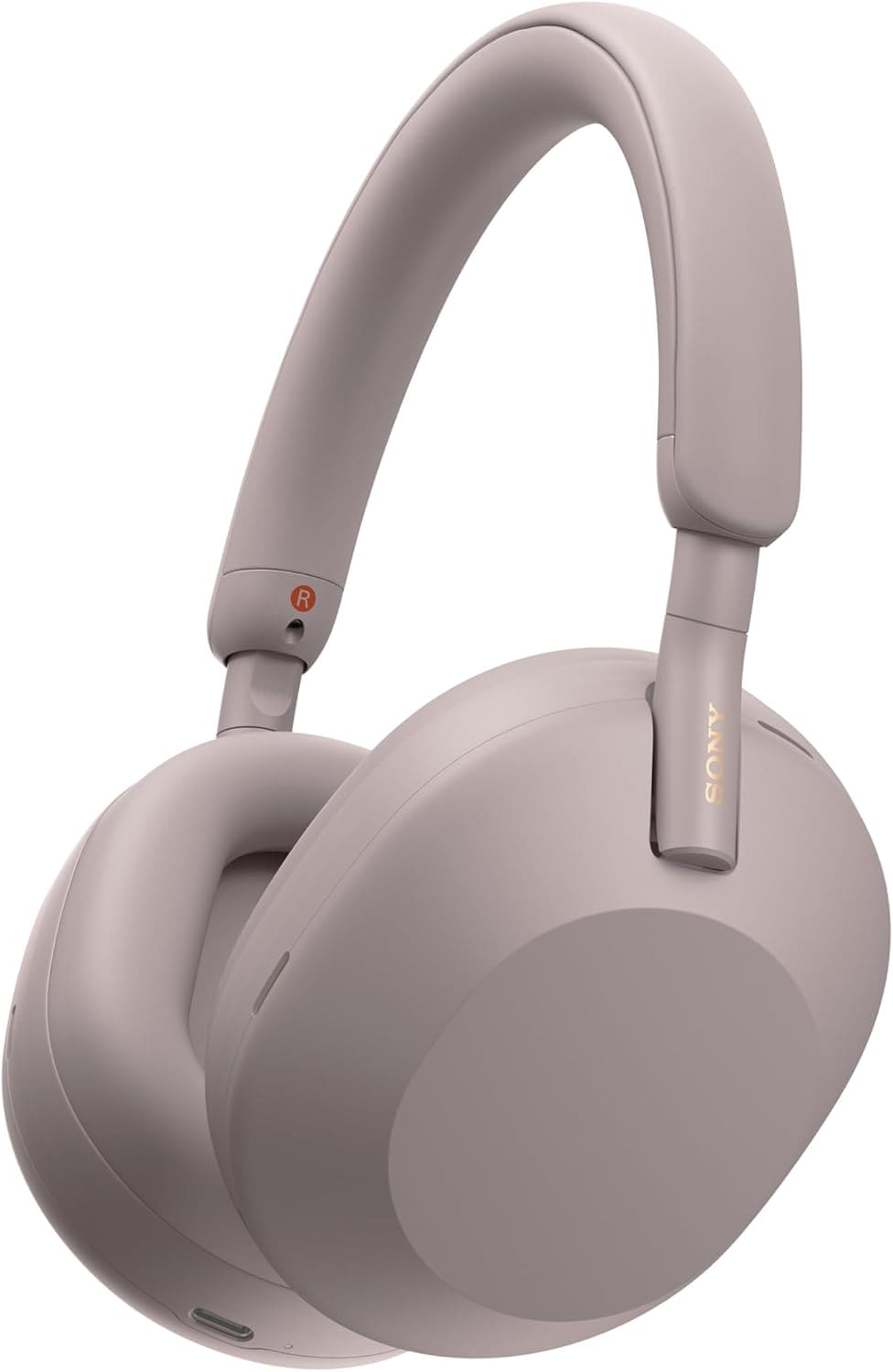
When I review premium headphones, I look far beyond a long feature list. I study the sound system, noise control, microphones, comfort, battery, wireless connection, controls, and daily usability. For this review, I checked Sony’s official technical information and compared the WH-1000XM5 with other premium headphones in the same class. I also looked at each feature from a practical buyer’s point of view. My goal is simple: explain what matters, what does not, and where this model has clear strengths or weaknesses. I will not hide the drawbacks just because this is a high-end Sony model. By the end, you should have enough clear information to decide whether the Sony WH-1000XM5 Premium Noise Cancelling Wireless Headphones in Smoky Pink are right for you.
✅ What I Like
- Excellent active noise reduction with two processors and eight microphones
- Auto NC Optimizer adjusts noise reduction automatically
- Detailed and enjoyable sound from the 30 mm driver system
- Supports LDAC, AAC, and SBC
- DSEE Extreme improves lower-quality digital audio
- Strong microphone system for voice calls
- Up to 30 hours of music with noise cancellation enabled
- Up to 40 hours with noise cancellation disabled
- Very useful quick charging
- Lightweight at about 8.82 oz / 250 g
- Soft over-ear design
- Can connect with two Bluetooth devices at the same time
- Touch controls are simple once you learn them
- Ambient Sound and Quick Attention are useful outside
- Works wirelessly or through a 3.5 mm audio cable
- Carrying case is included
- Smoky Pink finish gives it a softer and more stylish appearance
Sony officially lists a maximum 30-hour music runtime with noise cancellation active and 40 hours with it turned off. It also supports Bluetooth 5.2, SBC, AAC, and LDAC.
❌ Things I Would Change
- Premium pricing may be too high for casual listeners
- The earcups do not fold inward like some older travel headphones
- No water-resistance rating makes it less suitable for hard workouts
- The smooth exterior can require extra care to keep clean
- Touch controls may be less convenient than physical buttons when wearing gloves
- Full charging takes around 3.5 hours
- Some features depend on Sony’s companion app
- USB-C is mainly used for charging rather than being the main wired listening connection
- Newer competitors now offer features that were not common when the XM5 originally appeared
The non-folding design is probably the biggest practical issue for travelers. The supplied case helps, but the headphones still need more bag space than compact folding models.
🎯 Who Is This Headphone Best For?
The WH-1000XM5 makes the most sense for someone who spends a lot of time with headphones on. That could be an office worker, student, traveler, remote worker, content consumer, or music listener who wants fewer distractions. It is especially attractive when background noise is one of your biggest problems.
I would also consider it for people who regularly switch between a laptop and smartphone. Its two-device connection can save a surprising amount of trouble during the day. You could be listening to something from your computer and still keep your phone connected for calls.
It is also a strong choice for people who want good wireless audio without moving into complicated audiophile equipment.
The Smoky Pink version is worth choosing when design matters to you as much as performance. Sony says the Smoky Pink model uses the same core features as the other WH-1000XM5 colors, so you are not giving up performance for the different finish.
I would look elsewhere if you mainly want cheap headphones, something very small for travel, or headphones for running in rain and heavy sweat.
Buy this product from Amazon

📋 Technical Details
| Item | Sony WH-1000XM5 |
|---|---|
| Model | WH-1000XM5 |
| Style | Over-ear |
| Headphone design | Closed, dynamic |
| Driver | 30 mm |
| Magnet | Neodymium |
| Weight | Approx. 8.82 oz / 250 g |
| Noise cancellation | Active |
| Noise control system | Two processors + eight microphones |
| Automatic optimization | Auto NC Optimizer |
| Ambient listening | Yes |
| Quick Attention | Yes |
| DSEE Extreme | Yes |
| Hi-Res support | Yes |
| Wired input | Stereo mini jack |
| Cable | Detachable, single-sided |
| Cable length | Approx. 3.94 ft |
| Wired frequency response | 4 Hz–40,000 Hz |
| Bluetooth frequency response | 20 Hz–20,000 Hz at 44.1 kHz |
| LDAC frequency response | Up to 20 Hz–40,000 Hz under supported LDAC settings |
| Impedance, powered wired use | 48 ohms at 1 kHz |
| Impedance, powered off | 16 ohms at 1 kHz |
| Sensitivity, powered | 102 dB/mW |
| Sensitivity, powered off | 100 dB/mW |
| Bluetooth | Version 5.2 |
| Bluetooth band | 2.4 GHz |
| Wireless range | Approx. 32.81 ft / 10 m |
| Bluetooth profiles | A2DP, AVRCP, HFP, HSP |
| Audio codecs | SBC, AAC, LDAC |
| Multipoint | Two devices |
| Music battery, ANC on | Up to 30 hours |
| Music battery, ANC off | Up to 40 hours |
| Call battery, ANC on | Up to 24 hours |
| Call battery, ANC off | Up to 32 hours |
| Normal charging | Approx. 3.5 hours |
| Charging method | USB |
| Fast charging | Approx. 3 min for 3 hours of playback with compatible USB-PD equipment |
| Volume controls | Touch sensor |
| Passive wired use | Yes |
| Carrying case | Included |
| Audio connection cable | Included |
| USB cable | Included |
| Color reviewed | Smoky Pink |
These core measurements and connection specifications come from Sony’s official WH-1000XM5 documentation.
🎧 My Experience-Based Take on the Sony WH-1000XM5
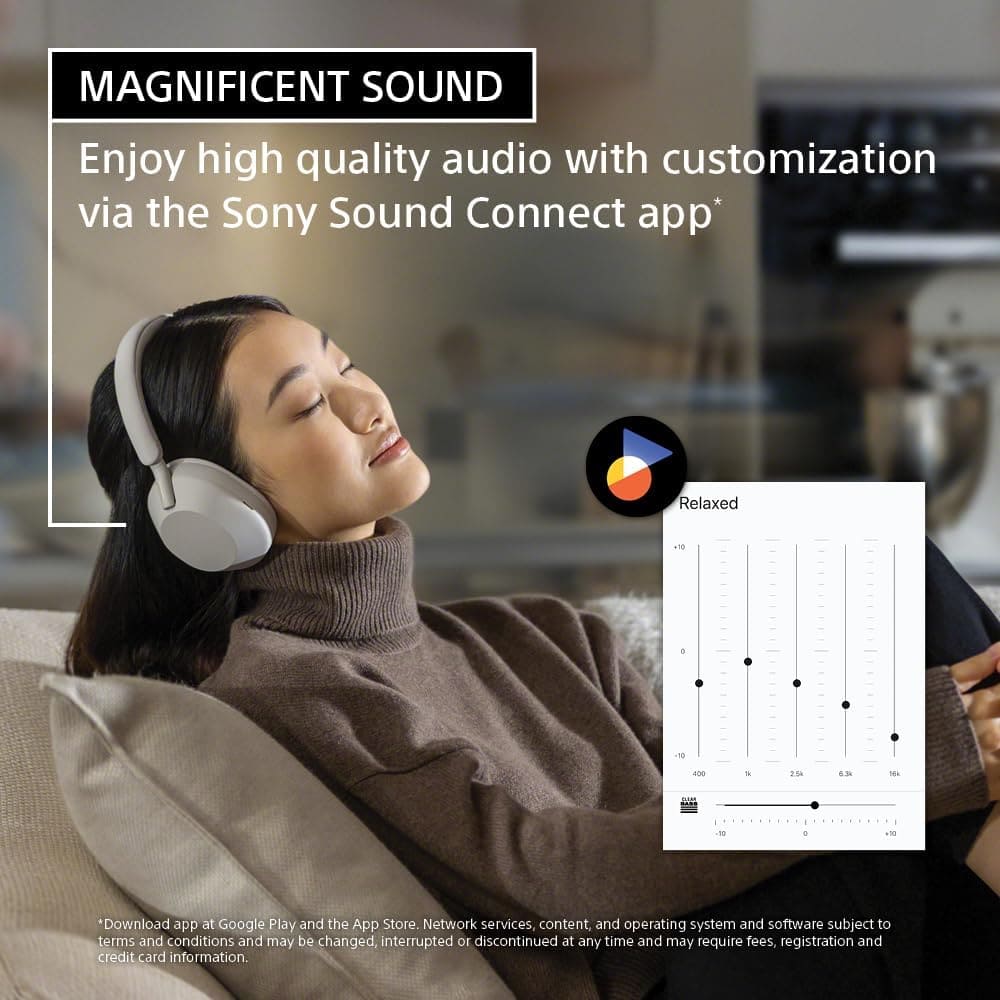
A Much Quieter Space Around Your Music
Noise reduction is probably the first reason I would put the XM5 near the top of a premium-headphone shopping list.
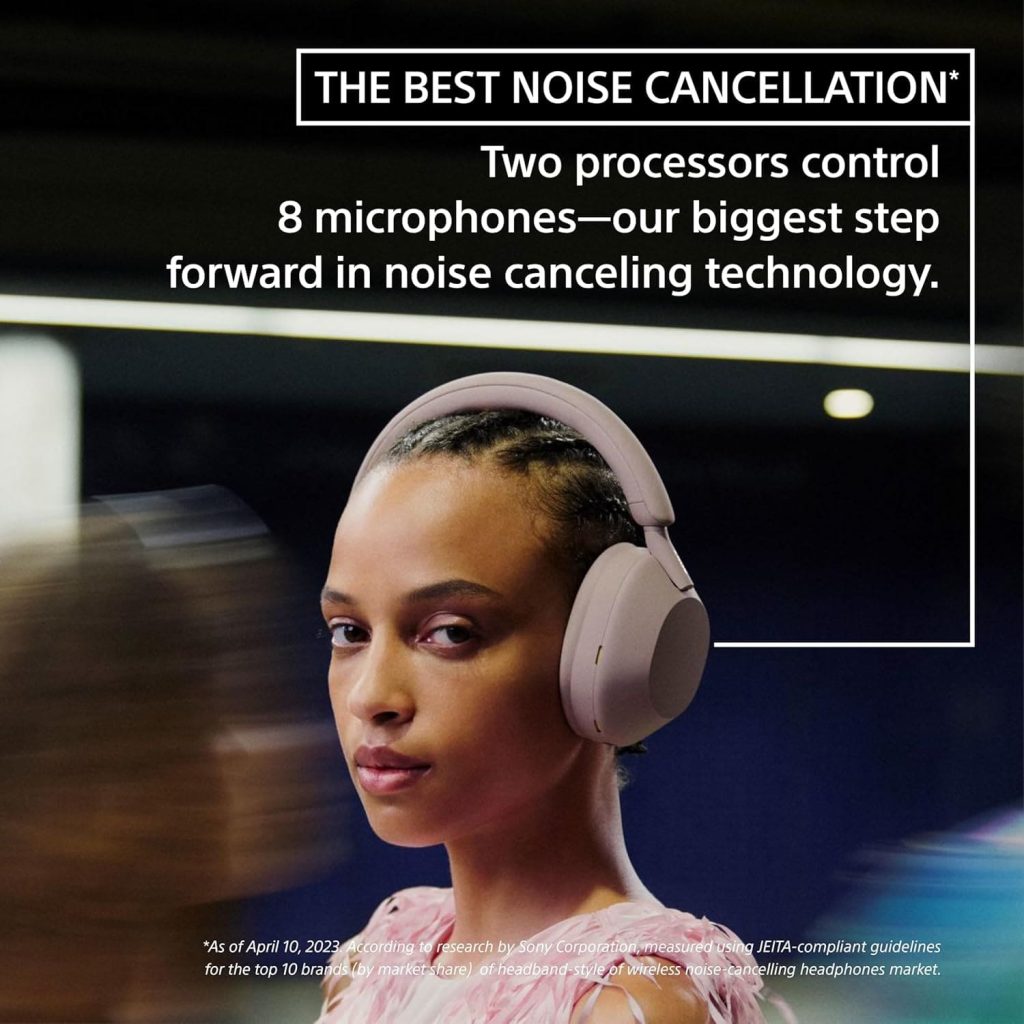
Sony uses eight microphones controlled through two processors. The idea is not simply to turn on one fixed level of noise reduction. The headphones analyze outside sound and work to reduce it.
The Auto NC Optimizer adds another useful layer. It automatically changes noise cancellation according to environmental and wearing conditions.
The benefit becomes easy to understand when you imagine normal daily situations.
A fan is running beside you.
An air conditioner is making a constant low sound.
People are talking several desks away.
There is road noise outside.
You are sitting inside an aircraft or bus.
Instead of increasing your music volume to fight all that sound, strong ANC tries to remove much of the distraction first.
That matters to me more than simply making music louder.
If you’re like me, constant background sound can become tiring even when it is not extremely loud. A good ANC headphone creates a more controlled listening space.
This is useful for studying as well.
You could play light music at a comfortable volume while removing a large amount of surrounding noise. For many people, that is better than turning the volume up high enough to cover everything around them.
Ambient Sound When Silence Is Not Safe
Complete isolation is not always what you want.
When walking outside, waiting at an airport, or sitting somewhere that announcements matter, the Ambient Sound function lets outside sound come through.
Sony also includes Quick Attention.
This solves an annoying problem common with strong noise-cancelling headphones.
You should not need to remove the headphones every time someone speaks to you.
That small convenience becomes more valuable when you wear headphones for many hours.
🎵 Sound That Tries to Stay Detailed
The WH-1000XM5 uses a specially developed 30 mm driver, and Sony combines it with its Integrated Processor V1, DSEE Extreme, and support for high-resolution wireless playback through LDAC.
Do not be worried simply because you may have seen headphones with larger driver numbers.
Driver size alone does not decide sound quality.
Design, material, tuning, processing, enclosure construction, and amplification all matter.
For normal listening, the bigger benefit of the XM5 system is versatility.
It is made for more than one type of content.
Music should have body.
Voices should remain understandable.
Small details should not disappear easily.
Movies need enough low-end impact to feel engaging.
Podcasts need clear speech.
Sony also supports LDAC, which can transmit more audio data than basic Bluetooth codecs when you use compatible equipment.
For Android users with LDAC support, this can be a valuable extra.
Apple devices normally rely on AAC rather than LDAC, but the headphones also support AAC.
Buy this product from Amazon
DSEE Extreme Has a Practical Job
Not every file we listen to is high quality.
YouTube videos, old music files, online audio, and heavily compressed tracks can lose detail during compression.
Sony’s DSEE Extreme processing is designed to improve compressed digital sound.
It cannot magically turn a poor recording into a studio master.
That would be an unrealistic expectation.
But it gives Sony another tool for making ordinary everyday sources sound better.
And ordinary sources are exactly what most buyers use every day.
🎙️ Calling Is More Important Than It Looks
A headphone can sound wonderful with music and still become frustrating when someone calls you.
Sony uses beamforming microphones and signal processing to focus on the speaker’s voice. Sony markets the system as Precise Voice Pickup technology.
That matters if your headphones are also part of your work setup.
Think about a normal weekday.
You start with music.
Then a Zoom meeting begins.
Later your phone rings.
After that, you return to a podcast.
A premium wireless headphone should move through these tasks without becoming inconvenient.
The XM5 is built with that type of mixed use in mind.
I would put call performance fairly high on my buying checklist because poor microphones make expensive wireless headphones feel surprisingly cheap.
🔋 Battery Life Is One of Its Safest Advantages
Battery anxiety is one thing I do not want from expensive headphones.
Sony rates the WH-1000XM5 for up to 30 hours of continuous music with noise cancellation on.
Turn noise cancellation off and the maximum rating rises to 40 hours.
That is enough for several normal working days for many users.
Suppose you listen for four hours each day.
A theoretical 30-hour maximum means you are not charging every night.
For travelers, the benefit is even clearer.
A long flight plus time at the airport does not come close to using the whole battery under ideal conditions.
Actual battery life will naturally change with volume, wireless conditions, features, temperature, battery age, and other settings.
Three Minutes Can Save Your Morning
The quick-charge feature may be more useful than the large battery number.
With a compatible USB-PD power source, Sony states that roughly three minutes of charging can provide about three hours of playback.
Imagine finding the headphones nearly empty just before leaving home.
A few minutes connected to power could give you enough battery for a commute or work session.
That is a feature I consider genuinely practical rather than something added only for marketing.
☁️ Comfort for Long Listening Sessions
Premium sound means little when the headphone becomes painful after an hour.
The XM5 weighs around 250 grams.
That is an important number.
Compare it with the current AirPods Max 2, which Apple lists at approximately 386.2 grams.
The difference is around 136 grams.
You may not think 136 grams sounds important.
Put that weight on your head for several hours and it becomes much easier to understand.
Sony uses a lightweight structure and soft-fit material around the contact areas.
The headband is also slim.
For long office sessions, studying, movies, and travel, lower weight is one of the XM5’s strongest physical advantages.
There is one trade-off.
The structure does not fold inward into a very small shape.
So I like its wearing comfort more than its packing efficiency.
📱 Phone + Laptop Without Constant Reconnecting
Multipoint connection sounds boring until you start using several devices every day.
The XM5 can maintain connections with two Bluetooth devices simultaneously. Sony confirms that its multipoint feature supports two devices at once.
Here is the situation where it becomes useful.
Your laptop is playing a video.
Your phone is beside you.
A call arrives.
With a properly configured multipoint setup, you do not want to open Bluetooth settings, disconnect the laptop, search for the headphones on your phone, connect them, take the call, and reverse everything afterward.
That process is annoying.
Multipoint removes much of that friction.
For remote workers, students, and office users, I consider this one of the most useful everyday features.
👆 Touch Controls Keep the Ear Cup Clean
Sony uses a touch sensor for volume and playback functions rather than covering the earcup with many physical buttons.
The advantage is a clean design.
Once you learn the gestures, basic changes can be made directly from the headphone.
I like this idea for normal indoor use.
There is still a reason some buyers prefer buttons.
Physical controls are easier to feel without thinking, especially when wearing gloves.
So this part comes down to preference rather than a clear win.
Buy this product from Amazon
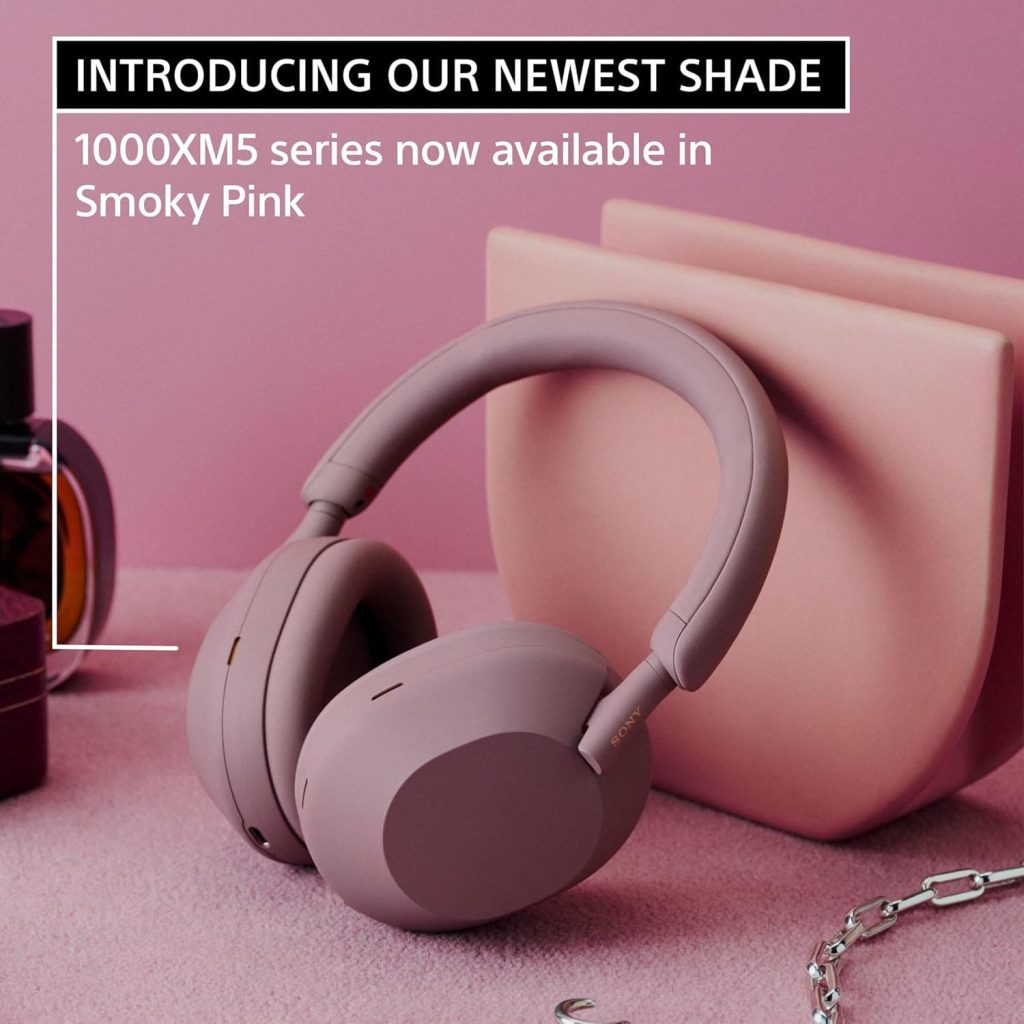
🌸 Smoky Pink Makes the XM5 Feel Less Ordinary
Most premium technology products are sold in safe colors.
Black.
Silver.
Dark blue.
The Smoky Pink model changes the personality of the XM5 without changing its main performance.
Sony describes it as the same WH-1000XM5 platform in a soft pink finish.
I think this matters more than people sometimes admit.
Headphones are visible.
Large over-ear headphones become part of what you are wearing.
A softer color can make them feel less like office equipment and more like a personal accessory.
And because Sony has not reduced the technical features for this color, you can choose the style without accepting a performance penalty.
🧳 The Case Helps, but Travel Size Could Be Better
Sony supplies a carrying case with the headphones. It also includes the connection cable and USB cable.
I strongly prefer seeing a proper case included with expensive headphones.
You are buying something designed to travel.
It should not be loose inside a backpack next to chargers, keys, and other equipment.
My main criticism is still the physical shape.
The earcups swivel, but the structure does not collapse as much as some folding headphones.
That means the case protects the XM5 well but does not completely solve the space issue.
For someone who travels with a small backpack only, this deserves consideration.
🔌 Wireless When You Want It, Cable When You Need It
The WH-1000XM5 includes a stereo mini-jack input and supports passive operation.
I like having this backup.
Wireless is convenient until you meet a device that does not support the connection you need.
An airplane entertainment system is a common example.
Older computers or audio equipment can be another.
Having a cable option makes a premium headphone more flexible.
And because passive operation is available, the headphone does not become completely useless as an audio device just because wireless operation is unavailable.
🆚 Sony WH-1000XM5 VS Others
For a current premium comparison, two obvious competitors are Bose QuietComfort Ultra Headphones (2nd Gen) and Apple AirPods Max 2.
| Feature | Sony WH-1000XM5 | Bose QC Ultra 2nd Gen | AirPods Max 2 |
|---|---|---|---|
| Design | Over-ear | Over-ear | Over-ear |
| Active noise reduction | Yes | Yes | Yes |
| Sony/Bose/Apple special processing | Auto NC Optimizer | CustomTune / ActiveSense | H2 processing |
| Main rated battery with ANC | Up to 30 hrs | Up to 30 hrs | Up to 20 hrs |
| Bluetooth | 5.2 | 5.4 | 5.3 |
| High-quality codec/features | LDAC | Premium Bose processing | Apple ecosystem + USB-C lossless |
| Weight | Approx. 250 g | Approx. 264 g | Approx. 386.2 g |
| Multipoint | Yes, two devices | Yes | Apple ecosystem switching |
| Wired connection | 3.5 mm | Audio cable + USB audio options | USB-C |
| Carry solution | Carrying case | Carry case | Smart Case |
| Best reason to consider | Balance of ANC, battery, sound and low weight | Newer Bose platform and strong ANC | Deep Apple integration and spatial features |
Bose currently lists its second-generation QuietComfort Ultra at around 0.583 lb, Bluetooth 5.4, and up to 30 hours of battery life in its standard listening modes. Apple lists AirPods Max 2 at 386.2 g with Bluetooth 5.3 and up to 20 hours of listening with ANC active.
Sony vs Bose
Bose is one of the strongest alternatives when noise cancellation is your number-one requirement.
Its latest QC Ultra generation is also newer technology.
Bose adds CustomTune, multiple listening modes, Immersive Audio, and Cinema Mode.
Sony answers with its excellent mix of ANC, LDAC, DSEE Extreme, multipoint, low weight, and strong battery life.
I would not say every buyer should automatically choose one over the other.
Sony makes a lot of sense when you want a very complete all-round package.
Buy this product from Amazon
Sony vs AirPods Max 2
AirPods Max 2 has a major advantage for someone deeply connected to Apple products.
Apple now offers H2-powered features, Personalized Spatial Audio, Adaptive Audio, USB-C lossless audio, and close integration with its devices.
But the weight difference is hard to ignore.
Sony is around 250 g.
AirPods Max 2 is around 386 g.
For long listening sessions, I see that as a major practical advantage for the Sony.
Sony also offers a higher official maximum ANC battery figure: 30 hours versus Apple’s listed 20 hours.
⚖️ Where the XM5 Still Makes Sense Today
The most important thing to remember is that newer does not automatically mean better for every person.
The WH-1000XM5 has been on the market long enough that newer premium competitors now exist.
That can actually work in the buyer’s favor.
When the XM5 is sold at a good discount, its combination of performance becomes very difficult to ignore.
You still get:
Strong active noise reduction.
Good wireless audio support.
30-hour rated ANC battery life.
A lightweight over-ear design.
Useful microphones.
Two-device Bluetooth connection.
Fast charging.
Wired backup.
A proper carrying case.
That is a very complete package.
⭐ My Overall Rating
Noise Cancellation: 9.5/10
This remains one of the main reasons to consider the XM5.
Sound System: 9/10
The 30 mm design, LDAC support, DSEE Extreme, and Sony processing make it a strong wireless listening package.
Comfort: 9/10
Its low weight gives it a clear advantage for long use.
Battery: 9.5/10
Up to 30 hours with ANC and excellent emergency charging make battery management easy.
Calls: 9/10
The multi-microphone voice system gives the XM5 a serious work-and-call focus.
Connectivity: 9/10
Bluetooth 5.2 is no longer the newest version, but multipoint, LDAC, AAC, SBC, and wired use make the overall connection package very useful.
Travel Design: 8/10
The case is welcome, but I would still prefer a more compact folding structure.
Style: 9.5/10
The Smoky Pink finish gives this serious premium headphone a softer and more distinctive appearance.
Overall: 9.2/10
🏆 Final Buying Decision
The Sony WH-1000XM5 Smoky Pink remains a very strong premium wireless headphone because it does not depend on one impressive feature.
It combines several important strengths in one product.
The noise reduction is advanced.
The sound system is capable.
The battery is long-lasting.
Fast charging is genuinely useful.
The microphones make it practical for work.
Multipoint makes everyday device switching easier.
And its roughly 250 g weight helps during long listening sessions.
The biggest negatives are the premium price, lack of a compact folding design, and the fact that newer flagship competitors now offer some more modern features.
But those weaknesses do not remove the XM5’s main appeal.
In my opinion, the best buyer is someone who wants one premium headphone for music, work, travel, calls, movies, and daily listening rather than buying different headphones for different situations.
If the Smoky Pink WH-1000XM5 is available at a strong discount, it becomes even easier to recommend.
You are getting the same important XM5 technology found in the other colors, but with a finish that looks much less ordinary. For a buyer who values quiet listening, comfort, battery life, clean sound, and easy everyday use, this remains one of Sony’s most complete over-ear packages.